
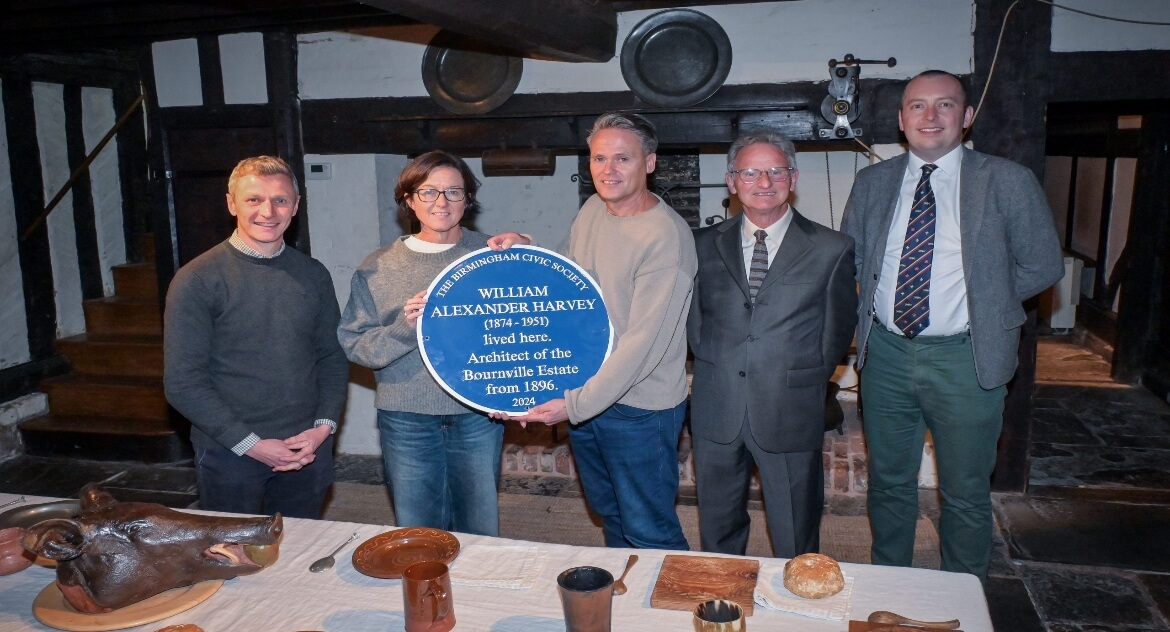
‘Celebrating Legacy’ – William Alexander Harvey
 Justine Marklew
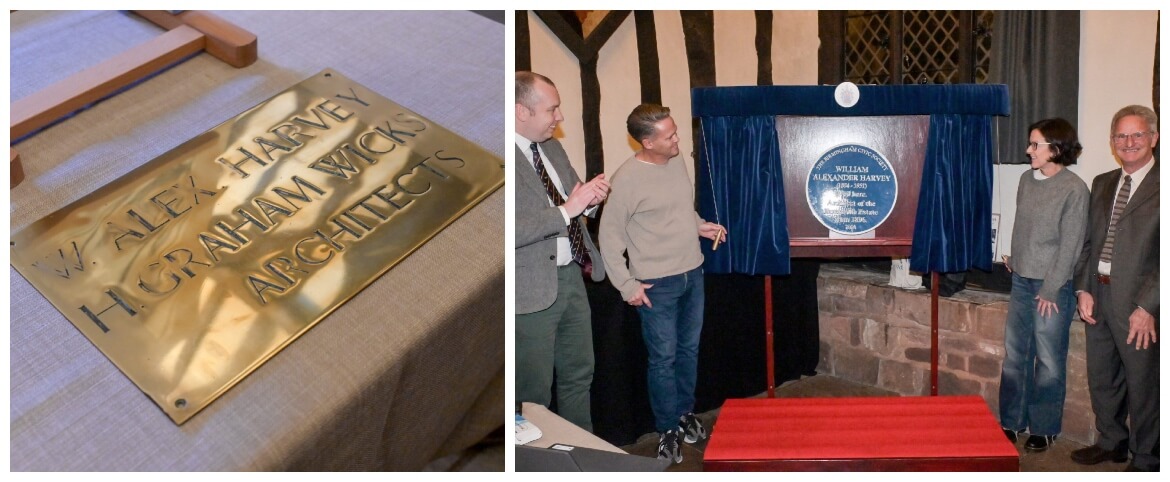
The Birmingham Civic Society – Blue Plaque unveiling took place on November 14th, 2024 to honour the life and work of architect William Alexander Harvey. Unveiled at Minworth Greaves, Bournville, the event was a celebration of Harvey’s lasting influence on the city and beyond. Harvey, a pioneering architect and planner, best known for his role in shaping the Bournville Estate, one of the UK’s most admired examples of garden city planning, and his vision for affordable, quality housing for the workers at the Cadbury Brothers’ Bournville chocolate factory. Harvey’s vision and creativity was to become a legacy of one of the most admired and attractive suburbs in the city of Birmingham.
When architect William Alexander Harvey was planning the rebuilding of Selly Manor in Bournville he realised the need for suitable materials to repair the old house. He scoured the Worcestershire and Warwickshire countryside in search of old buildings from which timbers, old glass and tiles could be bought and used for repairs. It was during this search that his attention was drawn to the skeletal remains of an old timber framed building on land belonging to the Birmingham Tame and Rea District Drainage Board, between the villages of Minworth and Curdworth, near Sutton Coldfield. Harvey had found an old building in Droitwich which had sufficient timbers to repair Selly Manor, but having inspected the structure at Minworth, Harvey felt there were enough remains to create a second building in Bournville.
In 1914 Harvey purchased the timbers at Minworth for £25 and arranged to have them moved to Bournville for safe storage until a time when they could be re-erected. With the rebuilding of Selly Manor not completed until 1916, and the cost and difficulty of such projects during the First World War, the reconstruction of the Minworth building was delayed. Harvey was asked to put together a proposal for the building’s reconstruction, something he had begun in 1914. However due to the expense and a concern that the entire Minworth structure should not dominate Selly Manor, it was decided only to reconstruct the oldest section – the medieval hall. The final building was completed in 1931 and was essentially a recreation of a hall house using the crucks at either end, and with an additional bay making it longer than the original.
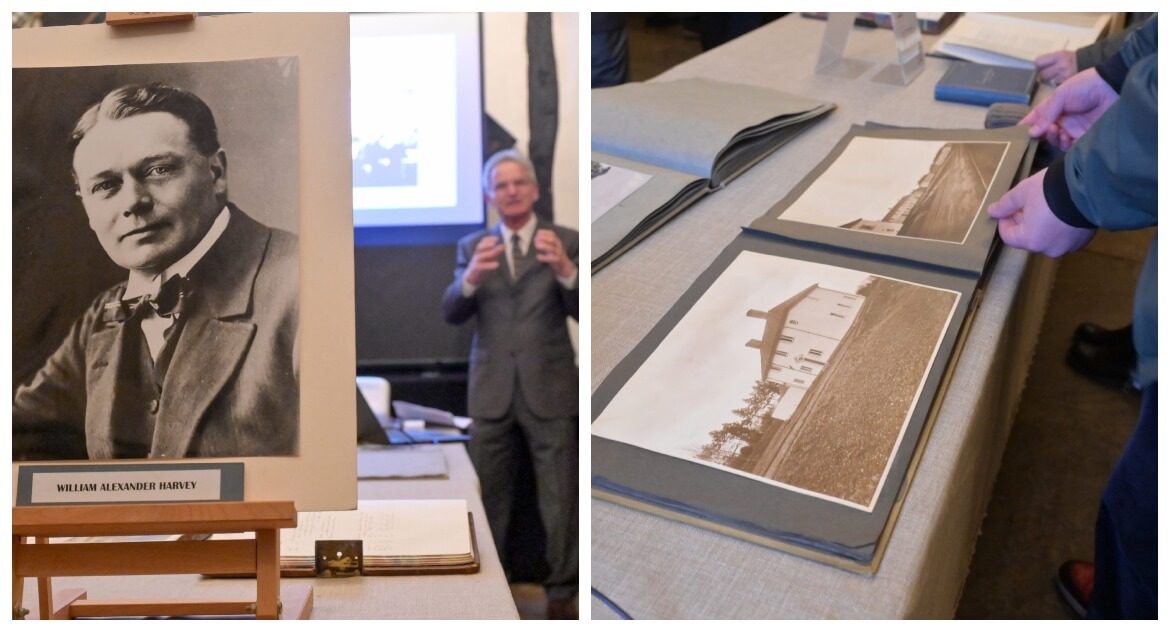
Born in Birmingham in 1874, William Alexander Harvey came from an artistic family and studied architecture at the Municipal School of Art in Birmingham. He was recruited as a very young man, aged just 21, to work for Bournville Village Trust, designing cottages for the new estate, an amazing opportunity for a such a young and relatively inexperienced architect. He became best known for simplified cottage designs which led Bournville to be considered a leader in housing estate development.
In 1904 Harvey left Bournville Village Trust to set up his own practice, Harvey and Wicks, but continued to design most of the public buildings in the village as well as houses, estates, municipal buildings and churches in other areas of Birmingham and the country. He was established as an expert on low-cost housing thanks to his 1906 book on model villages and his ideas were used by several local authorities. Harvey’s site design plans for the Bournville Tenants’ Estate were accepted in 1906 and he went on to design the majority of the houses on this estate.
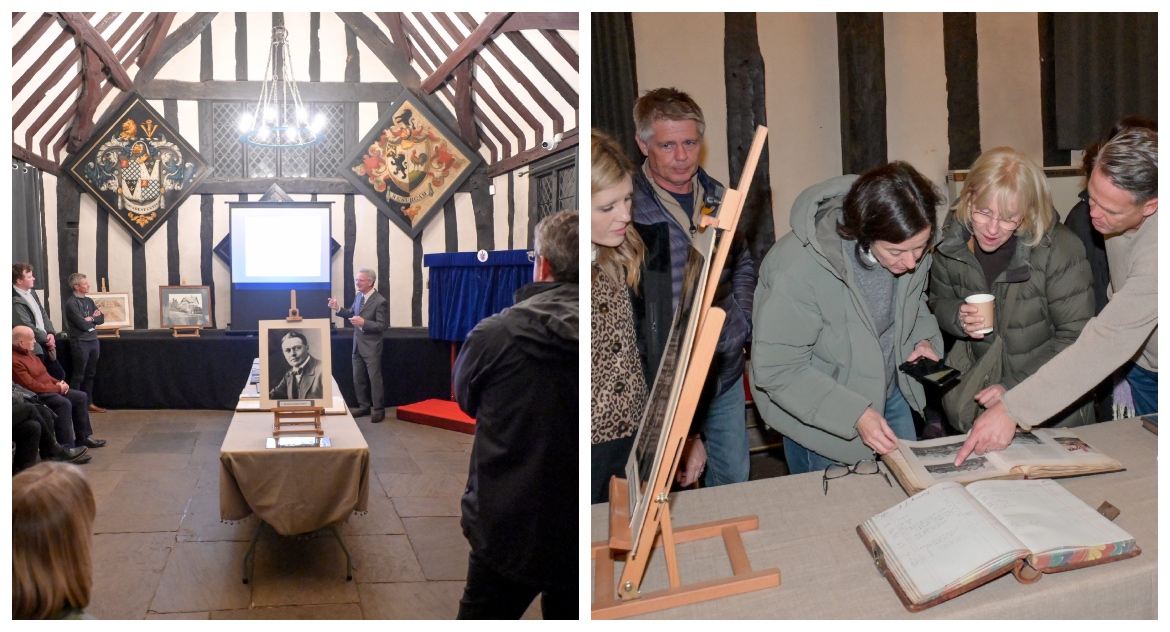
The Birmingham Civic Society wanted to recognise the contribution Harvey made to the objectives of George Cadbury’s model village – Harvey’s designs in Bournville reflect a time of fascinating social change in the city, as well as representing architectural achievements of national significance. As an architect and planner, Harvey helped to etablish simple, appealing and enduringly popular suburban pattern of 20th century England whilst also generating a body of soundly consturcted and well-designed public buidlings. “His life with a local focus, but wider impact.” (Michael Harrison).
A stated objective of the Bournville Estate was “to make it easy for working men to own houses with large gardens secure from the danger of being spoilt either by the building of factories or by interference of the enjoyment of sun, light and air” (Archives of the Bournville Village Trust, Prospectus for the Bournville Building Estate). Harvey expressed his disgust at overcrowded slums and his distaste for the ‘desolate row upon row of ugly and cramped villas’ which threatened to engulf Britain’s cities. He was one of a younger generation of architects who were turning their attention to working class and lower middle class housing and site planning. Harvey can be seen as a promising and committed young architect who brought together ‘the two movements of housing reform and the revival of domestic architecture’. (Harvey, 1906, p. 6)
In his own words, Harvey states, “If it be asked, with regard to the problem of the housing of the people, what is Bournville’s contribution towards its solution, it would be stating its claims at the lowest to say that it stands as an example of what the village of the future may be, a village of healthy homes amid pleasant surroundings, where fresh air is abundant and beauty present, and where are secured to its people by an administration co-operative in nature numerous benefits which under present conditions are denied them elsewhere.” (Harvey, 1906, p15)
The Blue Plaque is located on W A Harvey’s home at 24 Linden Road and the current homeowners were delighted to be a part of the unveiling ceremony on 14th November 2024. Appropriately held at Minworth Greaves, guests enjoyed exploring a selection of the Bournville Village Trust archives relating to Harvey and his work and Michael Harrison, expert on the life and work of W A Harvey, gave an engaging presentation sharing his wealth of knowledge with guests.
Speakers:
Michael Harrison Specialist on the Life of W A Harvey, author of Bournville: Model Village to Garden Suburb, Chris Adamson Chair of Heritage Committee, Daniel Callicott Heritage Manager Bournville Village Trust
Venue: Minworth Greaves –
For a detailed understanding of W A Harvey’s impact and list of architectural works read the chapter by Michael Harrison in Birmingham’s Victorian and Edwardian Architects, edited by Phillada Ballard, published by Oblong Creative Limited 2009, ISBN 9780955657627.
W A Harvey’s own publication – The Model Village and its Cottages: Bournville, 1906, published by B T Batsford – can be viewed at Internet Archive, subject to copyright restrictions.
About Birmingham Civic Society
Founded in 1918, the Birmingham Civic Society has played a pivotal role in the city’s development, working on a range of projects that reflect its commitment to heritage, urban planning, public art, and fostering active citizenship. With a focus on collaboration and innovation, the Society looks forward to continuing its mission for generations to come. The Society is a member-led registered charity
To learn more about the Society’s initiatives, membership, and trustee opportunities, please visit the new website: https://birminghamcivicsociety.org.uk/