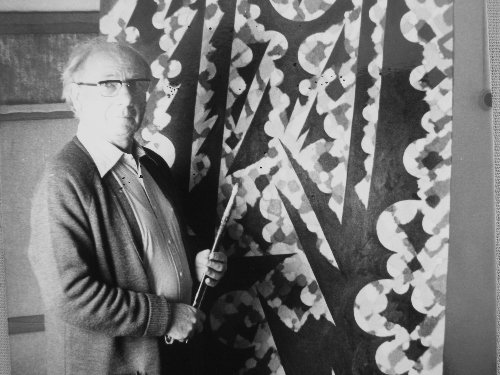
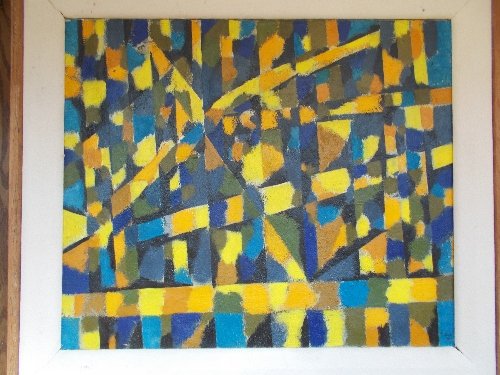
William Gear was a distinguished Scottish painter and educator, a significant figure in post-war abstract art, who later had a profound impact on the art scene in Birmingham.
Scottish roots to art detective
Born in Methil, Fife, Scotland, Gear initially trained at the Edinburgh College of Art from 1932 to 1936. His early artistic development also included studying with Fernand Léger in Paris in 1937, which exposed him to the European avant-garde. Gear’s career was interrupted by service in the Royal Corps of Signals during the Second World War, where he served in the Middle East and Europe. After the war, he worked as a “Monuments Man” in Germany, responsible for securing artworks and promoting modern German artists whose work had been suppressed. This period exposed him to a vast range of art and deepened his understanding of its cultural significance.
International recognition
From 1947 to 1950, Gear lived in Paris, where he became the only British artist to formally participate in the CoBrA group, an influential avant-garde movement from Copenhagen, Brussels, and Amsterdam. His work from this period was characterised by spontaneous, expressive, and energetic abstraction, often featuring strong black lines and bold colours. He also exhibited alongside Jackson Pollock in New York in 1949, a testament to his international standing. During his time in Paris Gear met and married American art lover Charlotte Chertok.
In 1950, Gear returned to England. His painting “Autumn Landscape” won a purchase prize at the 1951 Festival of Britain, which, due to its abstract nature, caused considerable public debate but cemented his reputation as a pioneering abstract artist in Britain. The painting is now held in the Laing Art Gallery in Newcastle-on-Tyne. From 1958-1964 Gear worked as curator at the Towner Gallery in Eastbourne, helping to develop their outstanding collection of modern British art.
Birmingham’s creative revolutionary
In 1964 Gear was appointed Head of the Faculty of Fine Art at the Birmingham School of Art (later part of Birmingham City University). He held this position until his retirement in 1975, profoundly influencing a new generation of artists. During his time in Birmingham, he became a member of the Royal Birmingham Society of Artists in 1966 and actively supported young graduates. He also contributed to the development of Birmingham Museum and Art Gallery’s collection of modern art. William Gear continued to live and work in Birmingham for over thirty years, residing at 46 George Road, Edgbaston, until his death in 1997. He was elected a Senior Royal Academician in 1995. His works are held in major collections, including Birmingham Museum and Art Gallery, the Tate Gallery, and the National Galleries of Scotland.