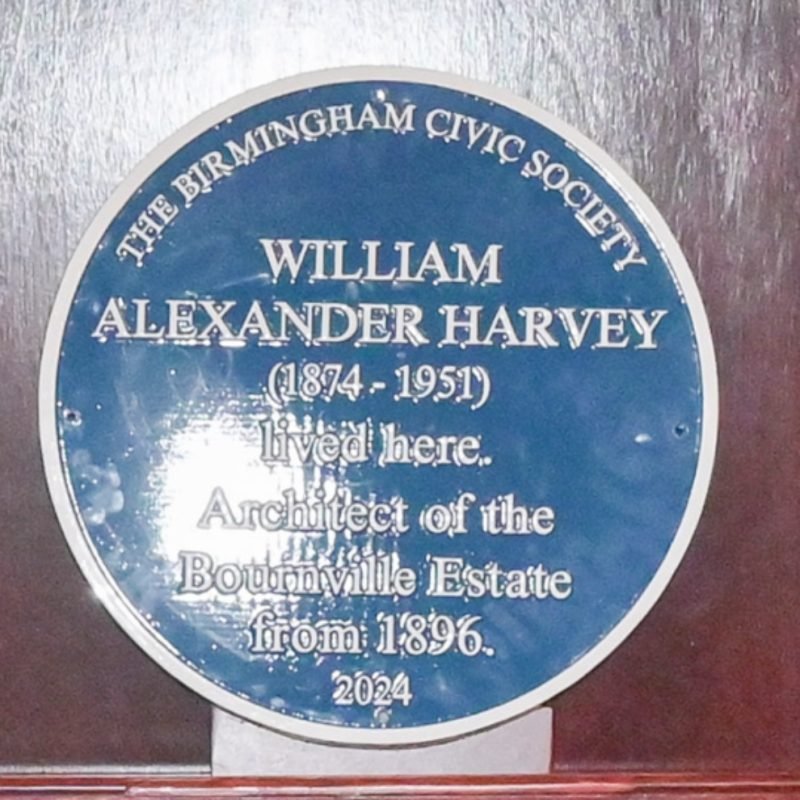
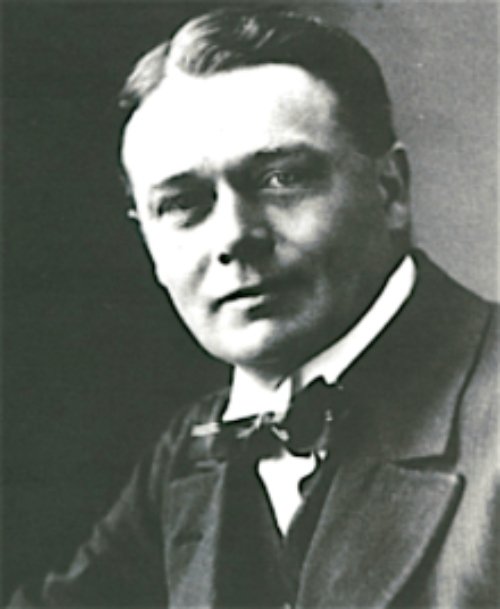
William Alexander Harvey was a significant English architect, renowned primarily for his instrumental role in shaping Bournville, the pioneering “garden suburb” built by the Cadbury family in Birmingham.
Early promise and the Cadbury vision
Born in Birmingham in 1874 into an artistic family, Harvey received his architectural training at the Birmingham Municipal School of Art. His career took a pivotal turn in 1895 when, at the remarkably young age of 20, he was appointed by George Cadbury to work on the housing designs for the new Bournville estate. Cadbury’s vision was to provide high-quality, affordable homes with generous gardens and open spaces for industrial workers, securing them from industrial encroachment and ensuring access to light and air. Influenced by the Arts and Crafts Movement, many of Harvey’s early designs for Bournville incorporated charming features such as stepped gables, small Venetian windows over canted bays, and timber corner porches with concave leaded roofs.
Building a legacy
From 1900, the Bournville Village Trust assumed responsibility for the development of the village, and Harvey remained in their employment until 1904. He then established his own architectural practice, Harvey and Wicks, which from 1914 was based in central Birmingham. Despite leaving the Trust’s direct employment, Harvey continued to design numerous public buildings within Bournville, including the Bournville Junior School (1902-1905), the Friends’ Meeting House (1905), and St Francis’ Church (1925), many of which are now Grade II listed. He also undertook significant restoration work, notably rebuilding Selly Manor (1912-1916) and Minworth Greaves (1929).
Beyond Bournville
Harvey’s expertise in low-cost housing gained national recognition, particularly after the publication of his 1906 book, ‘The Model Village and its Cottages: Bournville’. His schemes were adopted by various English local authorities, and he became an expert on the “cheap cottage problem.” His work also included designing houses, estates, municipal buildings, and churches elsewhere in Birmingham and further afield, such as Dudley Council House (1935). He was also a member of the Executive Council of The Birmingham Civic Society from 1918. Harvey died in Edgbaston at the age of 76 leaving Bournville as a testament to his architectural talent and his significant contribution to social housing reform in the UK.