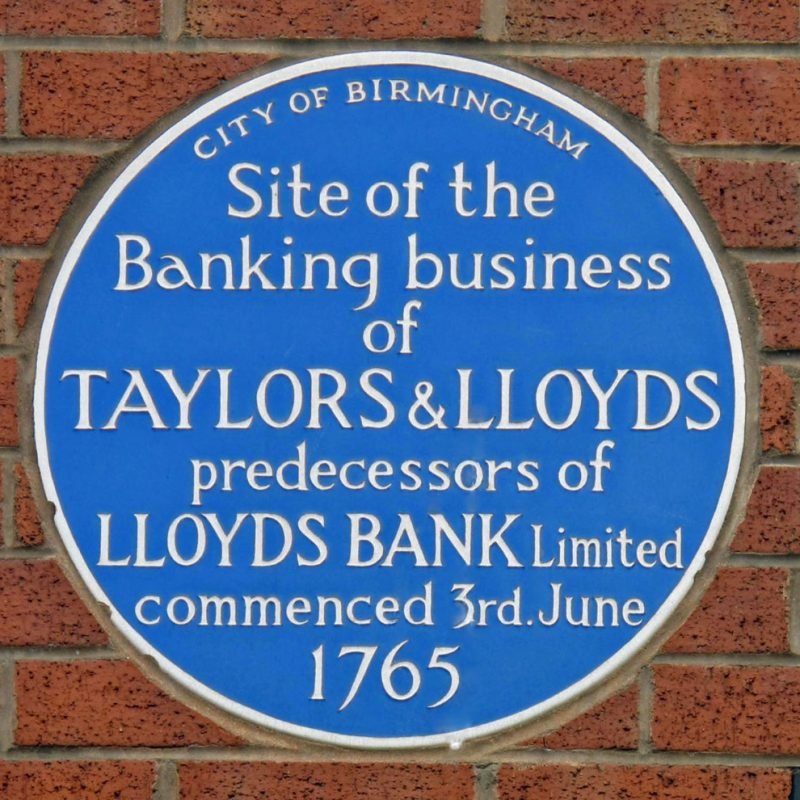
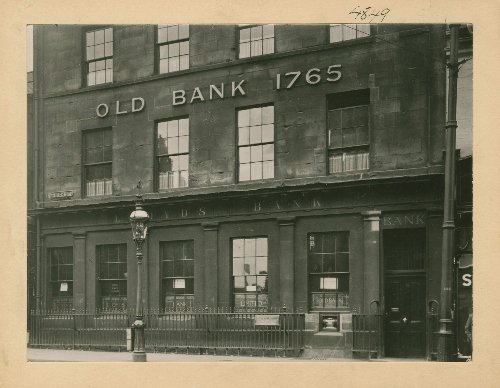
Lloyds Bank has its roots firmly planted in Birmingham, beginning as a private partnership between two prominent local families: the Taylors and the Lloyds.
The founding partnership (1765)
The bank, originally named Taylors & Lloyds, opened for business in June 1765 at 7 Dale End in Birmingham. It was founded by Sampson Lloyd II (1699-1779), a Quaker and successful iron founder, and John Taylor (1711-1775), a Unitarian and a wealthy manufacturer of buttons and japanned ware. Each of the two senior partners invested £2,000, and they were joined by their respective sons, Sampson Lloyd III and John Taylor Junior, who also invested equally.
This new venture marked Birmingham’s first proper bank, and it was particularly well-suited to the needs of a rapidly industrialising town. The founders, with their backgrounds in manufacturing and trade, understood the financial requirements of the booming local industries. Taylors & Lloyds quickly established itself as a “town bank,” primarily serving the small manufacturers, merchants, and traders who were driving Birmingham’s growth as the “workshop of the world.” The bank also played a crucial role in financing infrastructure projects, such as the Birmingham Canal Navigations.
From partnership to empire
For its first 99 years, the business thrived from this single Birmingham office, building a reputation for integrity and stability. The bank even issued its own banknotes, which were widely accepted throughout the region. The association with the Taylor family, whose name had taken precedence in the bank’s title due to John Taylor’s greater wealth and influence, came to an end in 1852 with the death of James Taylor, the last representative of the Taylor family in the banking firm. At this point, the bank’s name was changed to Lloyds & Company.
The mid-19th century brought significant changes to the banking industry, including new legislation that encouraged the formation of joint-stock companies. In 1865, precisely one hundred years after its founding, Lloyds & Company converted from a private partnership to a joint-stock bank, becoming Lloyds Banking Company Limited. This move provided the bank with a much larger capital base and allowed for unprecedented expansion.
Birmingham’s financial legacy
Under its new structure, Lloyds embarked on a remarkable period of growth, acquiring over 50 other banks, large and small, over the next five decades. A significant acquisition in 1884 was that of Barnetts, Hoares & Co. in Lombard Street, London, which brought with it the famous black horse logo that remains synonymous with Lloyds Bank today.
From its humble beginnings in Birmingham, Taylors & Lloyds grew to become one of the biggest British clearing banks, playing a central role in the nation’s financial landscape.