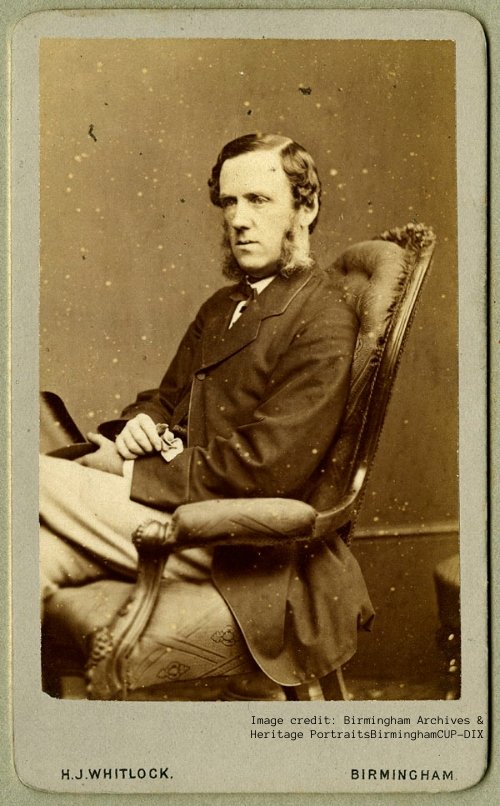
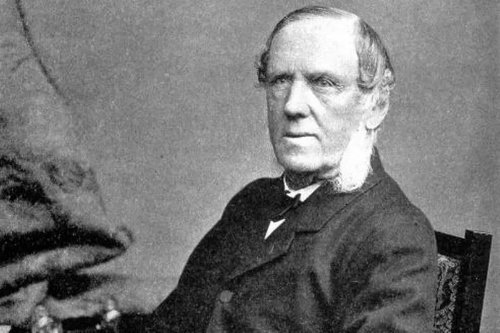
George Dixon was a prominent Birmingham businessman and a tireless advocate for educational reform, whose efforts profoundly shaped the development of public education in England.
From Yorkshire to Birmingham success
Born in Gomersal, Yorkshire in 1820, Dixon moved to Birmingham in 1838 and joined Rabone Brothers, a firm of merchants. He quickly rose through the ranks, becoming a partner in 1844 and eventually the head of the firm.
The Mayor who asked the right questions
Dixon’s passion for social improvement, particularly in education, became the defining feature of his public life. He entered local government, becoming a councillor for Edgbaston in 1863 and serving as Mayor of Birmingham in 1866. As Mayor, he initiated a crucial conference to address the widespread lack of education for children in the city. This led to the formation of the Birmingham Education Society in 1867, and, more significantly, the National Education League in 1869, of which he was the first president.
Fighting for every child
The National Education League, with Dixon at its helm and supported by figures like Joseph Chamberlain and R.W. Dale, became a powerful national lobbying force for universal, non-sectarian elementary education. Their persistent campaigning played a critical role in the passing of the Elementary Education Act of 1870 (Forster’s Act), which laid the foundation for compulsory education and led to the establishment of the first school boards across England and Wales.
Putting his money where his beliefs were
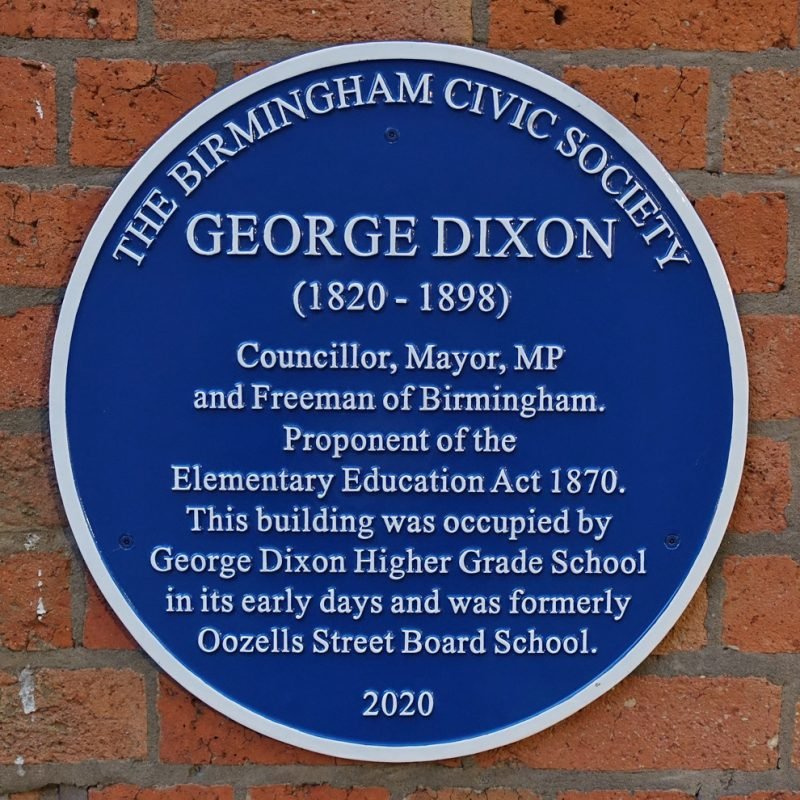
Dixon’s commitment to education was also practical. He financed several educational experiments in Birmingham, including the Bridge Street Technical School in 1884, which provided science and mechanics training. This successful model later inspired the Technical Instruction Act. In 1888, this school moved to new premises and was renamed the George Dixon Higher Grade School, eventually including girls in its curriculum. The current George Dixon Primary School and George Dixon Academy in Edgbaston are named in his honour.
The quiet revolutionary
Dixon also served as a Liberal Member of Parliament for Birmingham from 1867 to 1876, and later as a Liberal Unionist MP for the Edgbaston division from 1885 until his death. He retired from the Birmingham School Board in 1896, having served as its chairman for an impressive 21 years.
George Dixon was made an honorary freeman of Birmingham in 1898, the year he died. His name indirectly lives on in popular culture through the fictional character PC George Dixon, who first appeared in the film The Blue Lamp, produced by Sir Michael Balcon, a former pupil of the George Dixon School. Dixon’s unwavering dedication to universal education earned him the moniker “Father of Free Education” and left an enduring legacy in Birmingham and across the nation.