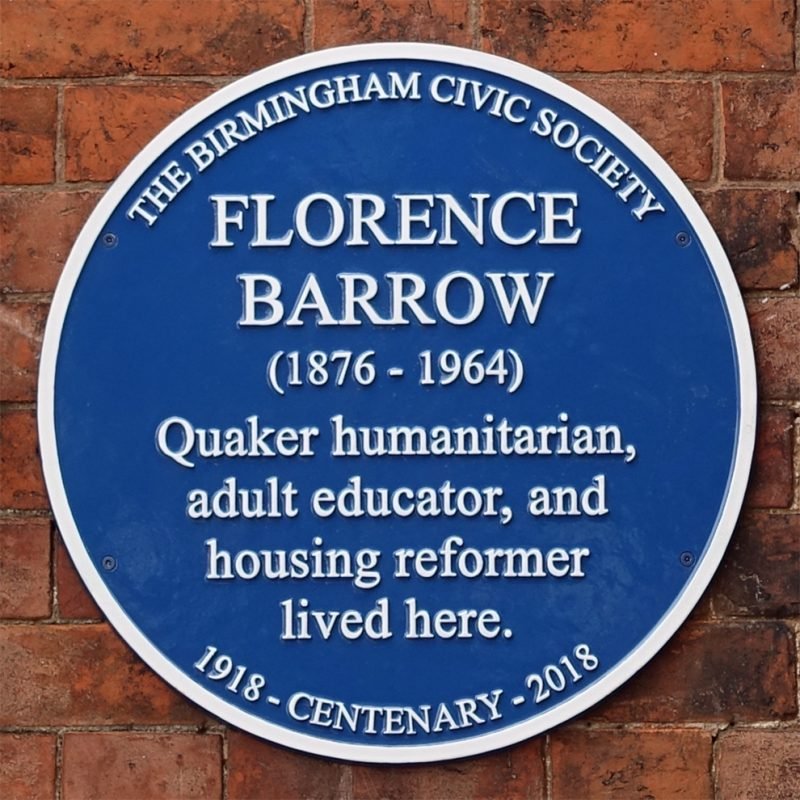
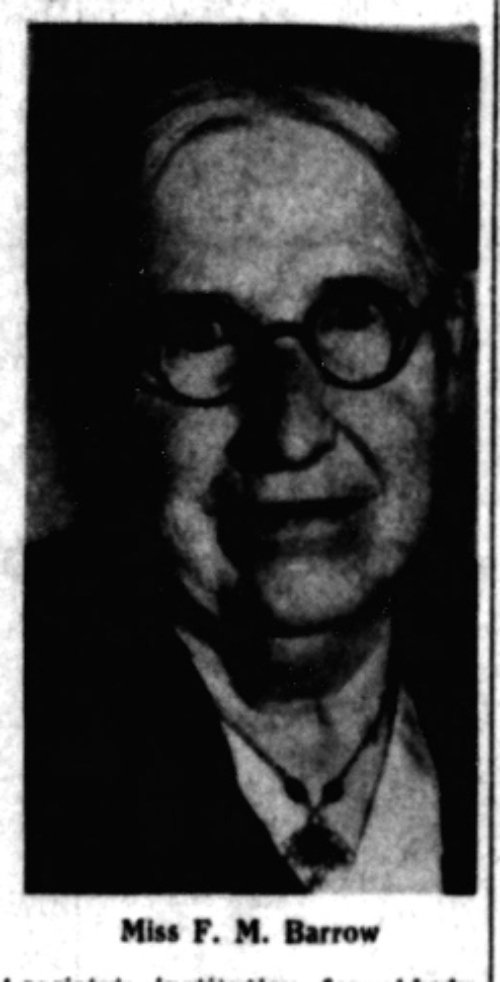
Florence Barrow was an humanitarian, social reformer, and Quaker, whose life was largely dedicated to improving the lives of others, both internationally and in her home city of Birmingham.
Born to serve Birmingham
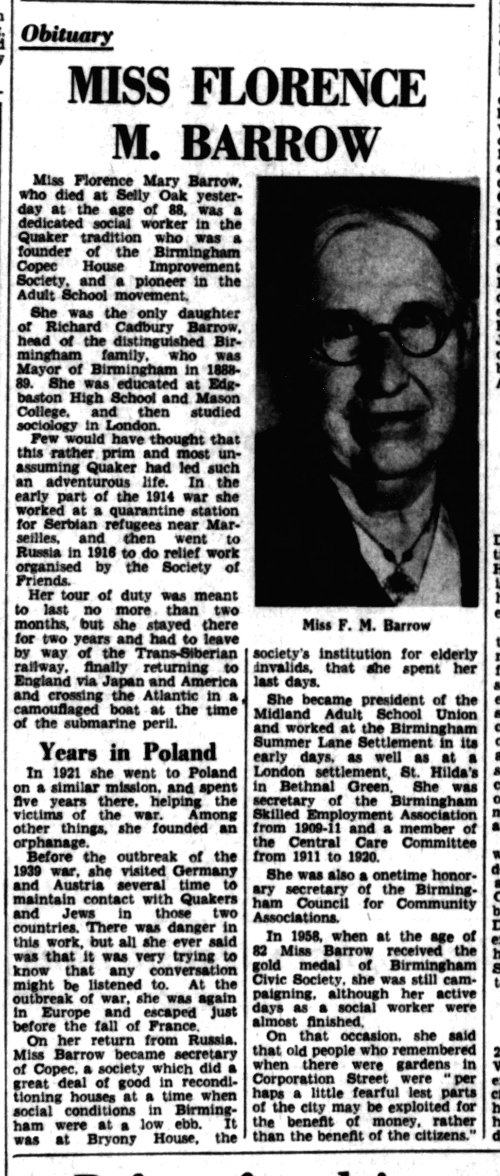
Born in Birmingham to a prominent Quaker family – her father, Richard Cadbury Barrow, was a businessman and a former Mayor of Birmingham – Florence was immersed in a tradition of civic service and social justice from an early age. She received her education at Edgbaston High School and Mason College in Birmingham. Demonstrating an early commitment to social welfare, she trained as a social worker and began teaching an adult school class for women in her late teens. Her early volunteer work also included serving at the Birmingham Women’s Settlement, providing educational and social services to women and children in impoverished neighbourhoods.
War zone pioneer
Florence Barrow’s international humanitarian work expanded during and after the First World War. From 1916, she embarked on relief efforts with the Friends’ War Victims’ Relief Committee, initially working with Serbian refugees in France. She then moved to Russia during the revolutions, where she was involved in feeding, clothing, and medical programmes. Following the war, she was one of the first civilians allowed into defeated Germany to assess conditions for Quaker relief services. She spent four years in Poland, leading the British and American Quaker relief efforts, providing food, clothing, medical aid, education, and crucially, housing in a war-devastated country. Her work in this period often involved facing challenging and difficult conditions.
Housing improvements
Upon her return to Birmingham in 1924, Barrow focused her energy on housing reform. She co-founded the Birmingham Conference on Politics, Economics and Citizenship (COPEC) House Improvement Society, which pioneered municipal slum clearance and the regeneration of inner-city housing. She was a driving force behind practical schemes for reconditioning, reconstruction, conversion, and rebuilding for over 37 years, advocating for decent and affordable homes for all, including low-rental accommodation for single working women and sheltered housing for the elderly.
Lasting legacy
Florence Barrow also served on the Council of the Birmingham Civic Society for 30 years, often as its only female member for much of that period. In 1932, at the age of 56, she supported refugees in Syria, Salonika, and Egypt and later in the 1930s undertook discreet missions for the Quakers into Nazi Germany and Austria, transporting messages for endangered Jewish individuals. Florence Barrow died in 1964, and as the testimony provided by Warwickshire Monthly Quaker meeting to the Britain Yearly Meeting put it, ‘Quiet and modest, her outward appearance gave little indication of the power within.’