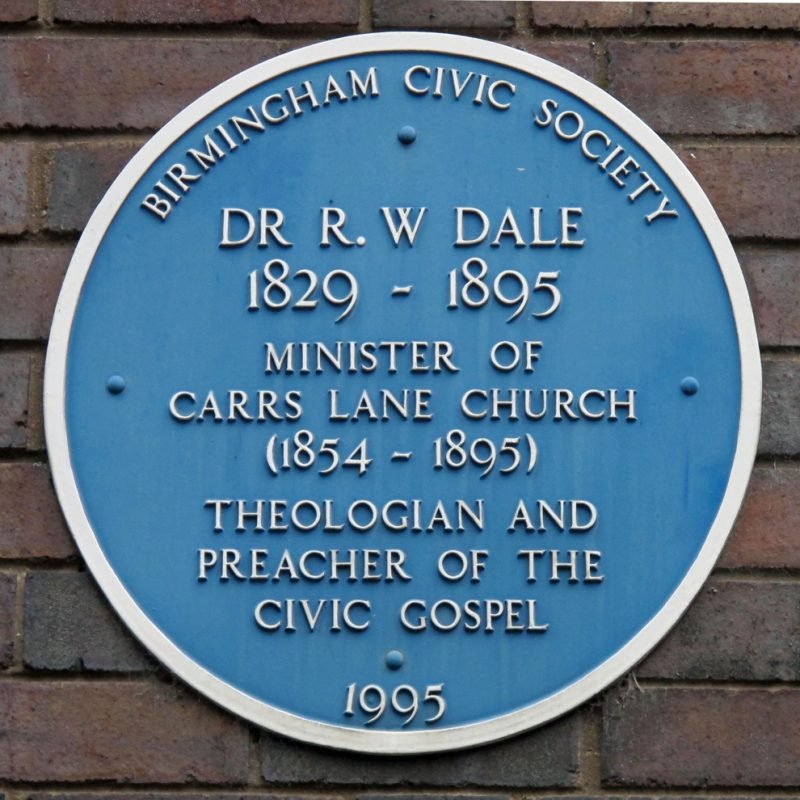
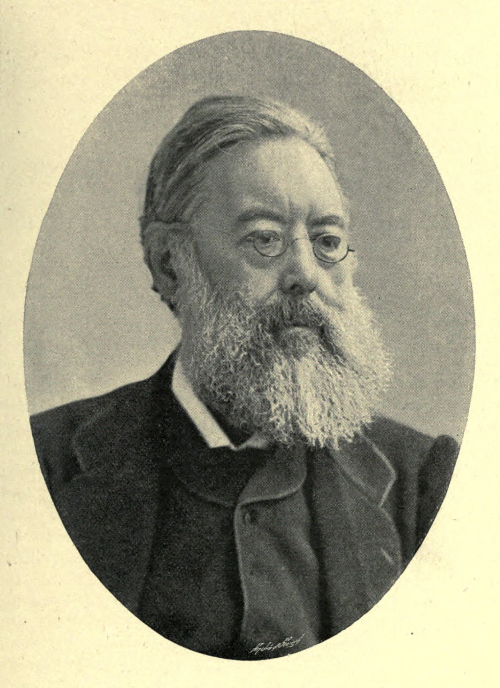
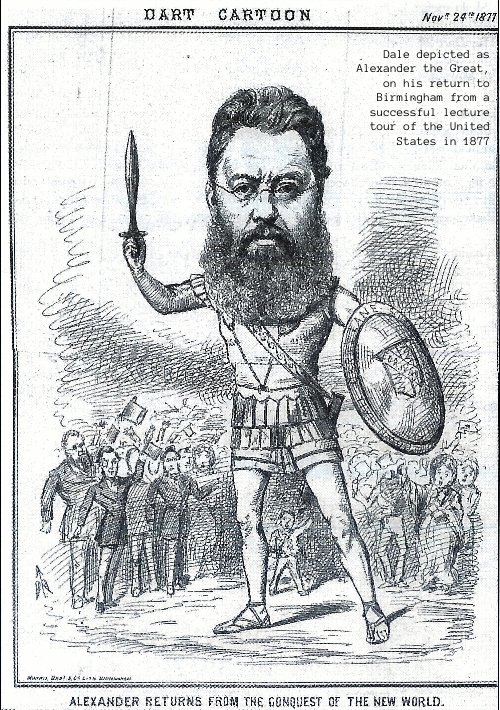
R.W. Dale was a hugely influential English Congregational minister, theologian, and social reformer, whose work deeply impacted the civic and religious life of Birmingham.
From London student to Birmingham giant
Born in London on 1st December 1829, Dale was educated for the Congregational ministry at Spring Hill College in Birmingham. In 1853, he was invited to become co-pastor with John Angell James at the renowned Carrs Lane Chapel in Birmingham. Upon James’s death in 1859, Dale became the sole pastor, a position he held for the remainder of his life. Under his leadership, Carrs Lane Chapel became a vibrant spiritual and intellectual hub, attracting large congregations and establishing an international reputation.
The Civic Gospel revolution
Dale was a fervent proponent of what became known in Birmingham as the “Civic Gospel,” a philosophy championed by George Dawson, that argued for the moral and religious duty of citizens to engage in public life and strive for social improvement. He believed that serving the town council to improve the well-being of Birmingham had significant moral and religious worth. This belief underpinned his advocacy for free public education, social improvement, the extension of the voting franchise, and the recognition of trade unions. He was particularly instrumental in educational reform, holding a seat on the Birmingham School Board and serving on the Royal Commission of Education. He also played a key role in the relocation of Spring Hill College to Oxford, where it was renamed Mansfield College, of which he became chairman of the council.
Birmingham’s moral compass
A staunch Nonconformist, Dale was a strong advocate for the disestablishment of the Church of England, believing that political authority impaired the spiritual work of the church. He was a prolific writer, publishing numerous sermons, lectures, and theological works, including his influential volume, The Atonement (1875). He actively participated in the major public controversies of his day and was an ally of Birmingham’s Liberal reformers, including Joseph Chamberlain and John Bright.
Dr. R.W. Dale, who was awarded an LL.D. by the University of Glasgow and a D.D. by Yale University (though he rarely used the latter title), died in Birmingham on 13th March 1895. His integrity, powerful oratory, and profound commitment to social justice made him a national figure.