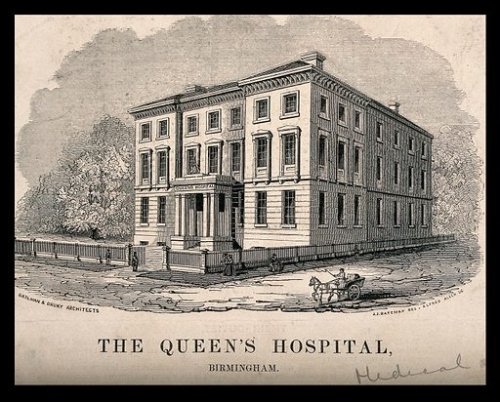
Birmingham has a distinguished history of medical innovation and provision, with two of its key institutions being Queen’s Hospital and the Birmingham Accident Hospital. While they ultimately merged into the larger Queen Elizabeth Hospital system, their individual stories highlight different facets of healthcare development in the city.
Queen’s Hospital, Bath Row (Established 1840)
Queen’s Hospital has a foundational role in Birmingham’s medical education. It was established by William Sands Cox (1801-1875), a prominent local surgeon, who first set up a medical school in Temple Row in 1825. This school, initially called the Birmingham Royal School of Medicine and Surgery, formed the basis of what would become Queen’s College.
Where modern healthcare was born
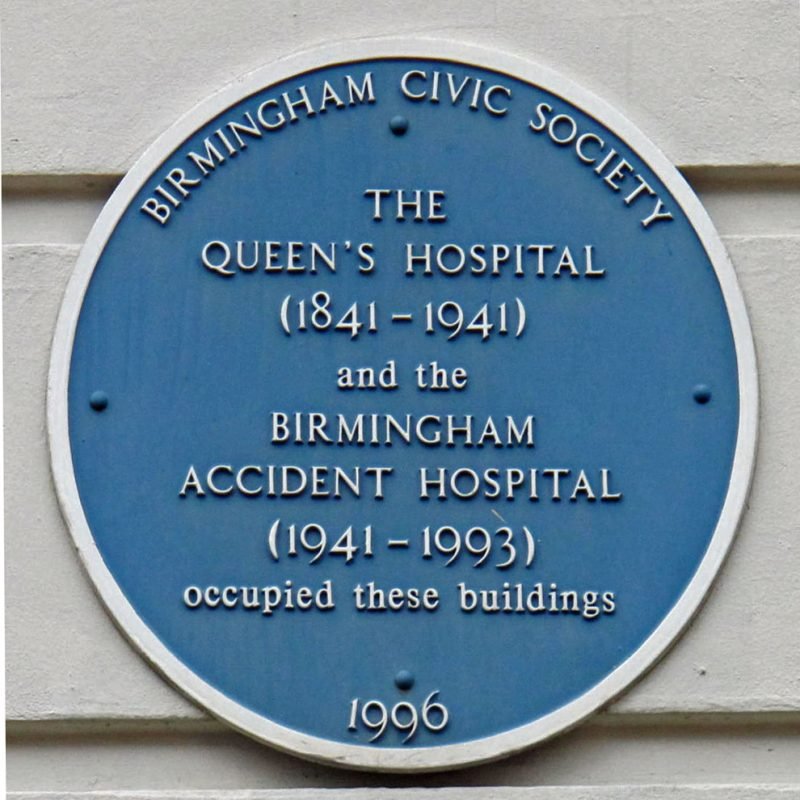
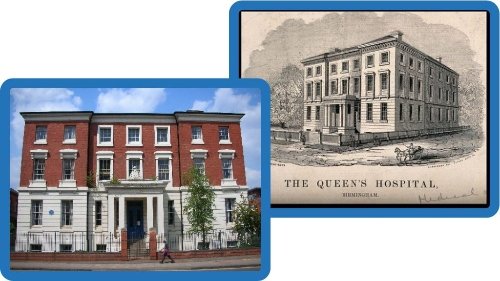
Cox recognised the crucial need for a dedicated teaching hospital where his medical students could gain practical clinical experience. Thus, Queen’s Hospital was founded on 18th June 1840 on Bath Row. It officially opened in 1841 with 70 beds, uniquely designed from its inception as a teaching hospital. In April 1841, Queen Victoria granted her patronage, allowing it to be named ‘The Queen’s Hospital at Birmingham’.
Medical milestones
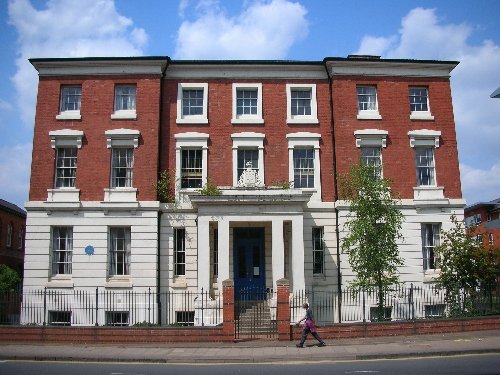
The hospital expanded rapidly, adding wards for infectious diseases by 1845. In 1875, it became a “free hospital,” abandoning the previous system where patients required subscriber tickets for admission. Queen’s Hospital played a significant role in medical advancements and became a central part of Birmingham’s evolving medical education, eventually being linked with Mason College (which later became the University of Birmingham). The original Bath Row building, designed by Bateman and Drury, is a Grade II listed building and stands today as student accommodation, “Queens Hospital Close”.
Birmingham Accident Hospital, Bath Row (Established 1941)
The Birmingham Accident Hospital, affectionately known as “The Acci,” was a world-renowned centre for trauma and rehabilitation, taking over the premises of the former Queen’s Hospital on Bath Row. Its establishment was a direct response to the urgent need for specialist treatment of industrial injuries and, soon after, wartime casualties.
“The Acci” – world’s first modern trauma centre
Recognised as arguably the world’s first purpose-built modern trauma centre, it was officially established in April 1941, during the height of World War II. Its location in industrial Birmingham, a hub of manufacturing, made it ideally placed to deal with the frequent and severe workplace accidents.
Revolutionary approaches
Under the pioneering leadership of figures like William Gissane (1898-1981), its first director, The Accident Hospital revolutionised the management of severe injuries. It focused on integrated care, from immediate resuscitation and surgery to long-term rehabilitation, aiming to return injured workers to their jobs. Innovations included advanced burns units, bacteriology laboratories, and even the development of mobile surgical units in collaboration with the Austin Motor Company. It played a crucial role in treating victims of the Birmingham Blitz during WWII.
Both Queen’s Hospital and the Birmingham Accident Hospital were integral to the city’s healthcare landscape for many decades. The Accident Hospital continued to operate until 1993, when its services were transferred to other sites, primarily Selly Oak Hospital and the new Queen Elizabeth Hospital in Edgbaston, which opened in 2010 and consolidated many of Birmingham’s acute medical services.