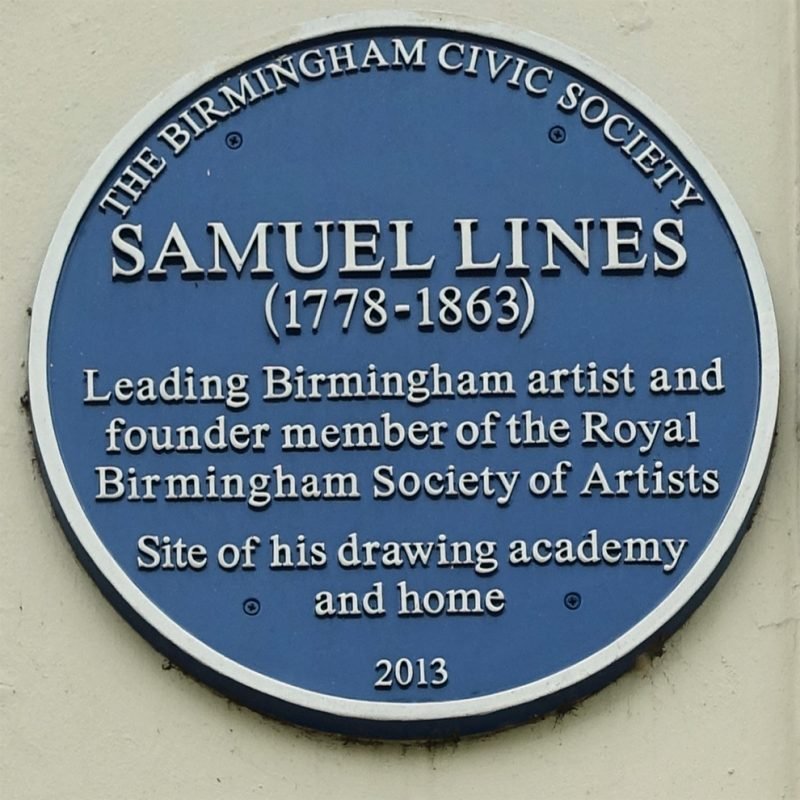
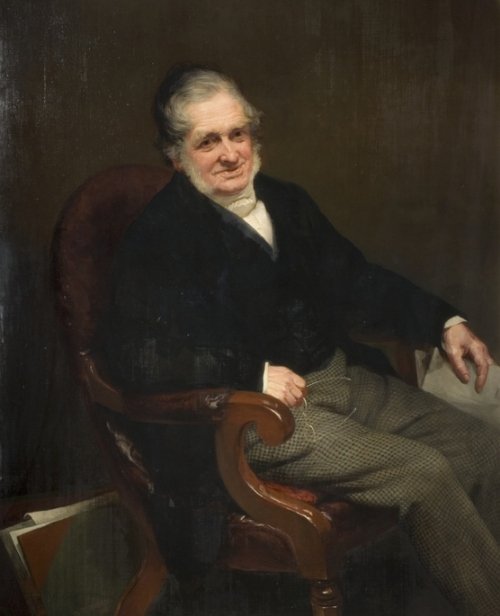
Samuel Lines was a highly significant figure in the development of art and art education in Birmingham during the early 19th century. He was a distinguished designer, painter, and art teacher, and a foundational member of what became known as the “Birmingham School” of landscape painters.
From farm boy to city artist
Born in the village of Allesley, Warwickshire, Samuel Lines’ mother was a schoolmistress. After an initial period working in agriculture, he moved to Birmingham in 1794, at the age of 16. He secured an apprenticeship as a designer with Thomas Keeling, a firm of clockmakers and enamellers. He also worked for other notable Birmingham manufacturers, including Messrs Osborn and Gunby, as a sword blade decorator, designer, and engraver, and for the die engravers Wyon and Halliday. These early experiences immersed him in the city’s renowned metal trades and decorative arts.
Building Birmingham’s art scene
Lines studied drawing under Joseph Barber, a respected landscape artist and teacher in Birmingham. Building on this training, in 1807, Lines opened his own academy for training pupils in drawing and painting in Newhall Street. This venture proved highly successful, allowing him to build his own house in Temple Row, where he continued to teach. His classes were renowned for their rigour, famously starting at five o’clock in the morning, with Lines personally rousing latecomers! Amongst Lines’ pupils were his own sons, Samuel Rostill Lines, Frederick Thomas Lines and Henry Harris Lines, all of whom became major figures in the lively visual arts scene of Victorian Birmingham.
Father of Birmingham’s art institutions
His influence extended beyond his own academy. In 1809, Lines was a key figure in establishing a life drawing academy in Peck Lane, along with other local artists including Moses Haughton and the Barber brothers (Joseph and Charles). This “Life Academy” was a crucial step towards creating a more formal art institution in Birmingham. It moved to larger premises in Union Passage in 1814, and in the same year, held Birmingham’s first public exhibition of local artists’ works. In 1821, with the help of wealthy local patrons, this group refounded itself as the Birmingham Society of Arts, taking up residence in a newly rebuilt premises on New Street. This society would eventually evolve into the Royal Birmingham Society of Artists (RBSA). Samuel Lines served as the society’s treasurer and curator until he resigned at the age of eighty, at which point he was elected an honorary life member.
Visual historian of Victorian Birmingham
Lines was also a talented landscape painter, particularly known for his topographical views of Birmingham. Several of his works are held in the collection of the Birmingham Museum and Art Gallery, providing invaluable visual records of the city in the early 19th century. Samuel Lines died at his home in Temple Row, Birmingham, on 22nd November 1863, at the age of 85, and is buried in the graveyard of St Philip’s Cathedral.