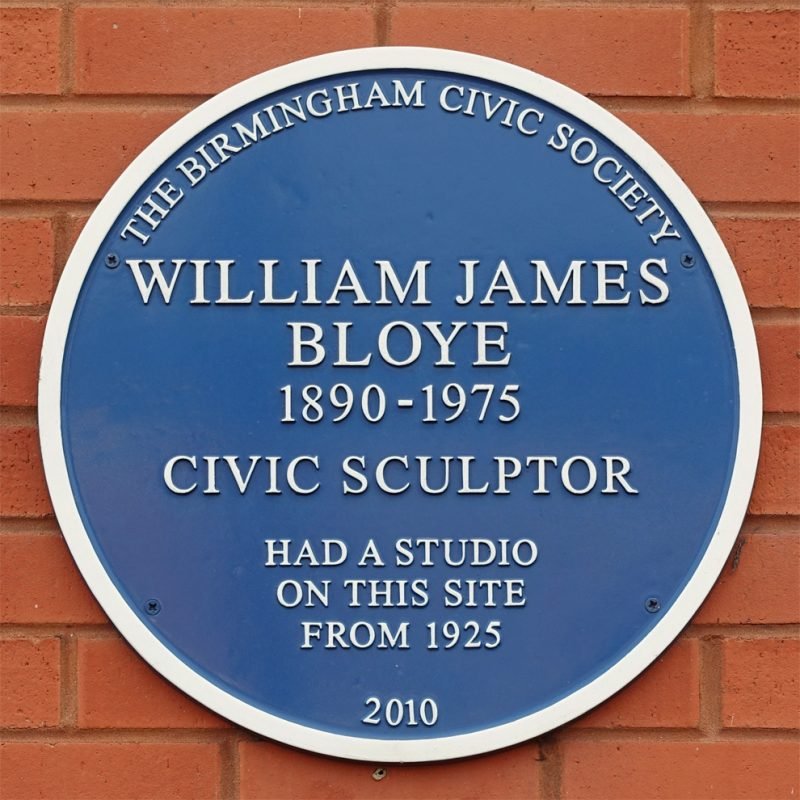
William Bloye was a distinguished English sculptor, a significant figure in Birmingham’s artistic landscape during the early and mid 20th century.
A Birmingham boy’s artistic journey
Born in Birmingham in 1890, Bloye attended Birmingham Municipal School of Art, where he developed a passion for sculpture. He later studied at the Royal College of Art in London, but World War 1 saw him serve in the Royal Army Medical Corps. In 1919 after 2 years of part time work, he was appointed a full time member of staff at Margaret Street School of Art and was for over 30 years the Head of Sculpture. He studied under Eric Gill, the eminent sculptor and typographer, for periods in 1921/2 and this training greatly influenced his subsequent work. He retired in 1956 but continued his professional practice until 1968.
Sculpting Birmingham’s identity
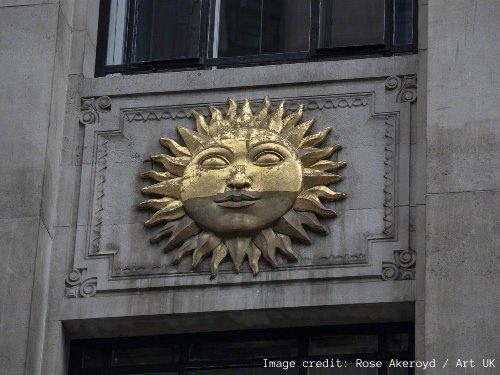
Over his career, Bloye enjoyed a close relationship with a number of the City’s leading architects who he met through his long membership of the Royal Birmingham Society of Artists, where he was President from 1948-50, and Birmingham Civic Society. Those collaborations meant his work was incorporated into the design of their buildings. Some were commercial offices and his reliefs in stone, often painted, reflected the use of the building. His reliefs can still be seen over the entrance to pubs across the City: sadly, a number have been demolished and his work lost.
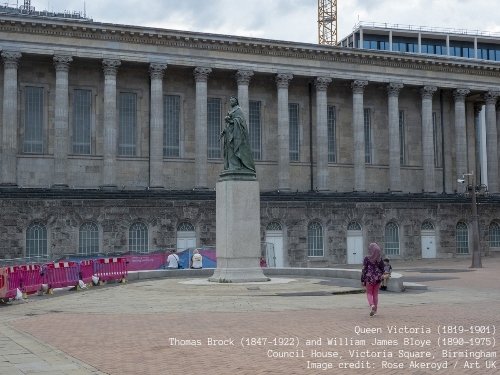
His sculpture was commissioned by public authorities for schools, libraries, police and health facilities and often displayed the City’s Coat of Arms or a shield. He established his own studio in Golden Hillock Road in 1925 and over the 40 years recruited many talented assistants he had trained to help in his practice. It is estimated that there are over 70 buildings in the City where his work can still be seen. He also has many memorials in churches. His best known work is a rare free standing sculpture of Watt, Boulton and Murdoch on Broad Street, so his informal title of Birmingham’s Civic Sculptor is well deserved.
Bloye beyond Birmingham
Bloye’s practice was much wider than Birmingham, he worked on important buildings in the Black Country, Coventry and Warwickshire. Recent research indicates that his work can be found at Leeds, Oxford and Cambridge Universities, on College buildings in Reading and Carlisle and Law Courts in Watford and Southport. He also completed commissions for the Royal Palace in Baghdad and was part of a team who made an important War Memorial in Canada.
A legacy in stone
It can safely be said that every active Birmingham citizen will pass a Bloye sculpture at least once every week. His work continues to give the City unique character and an enhanced sense of place as he has left a huge body of work in all neighbourhoods of Birmingham. He died in Italy in 1975.