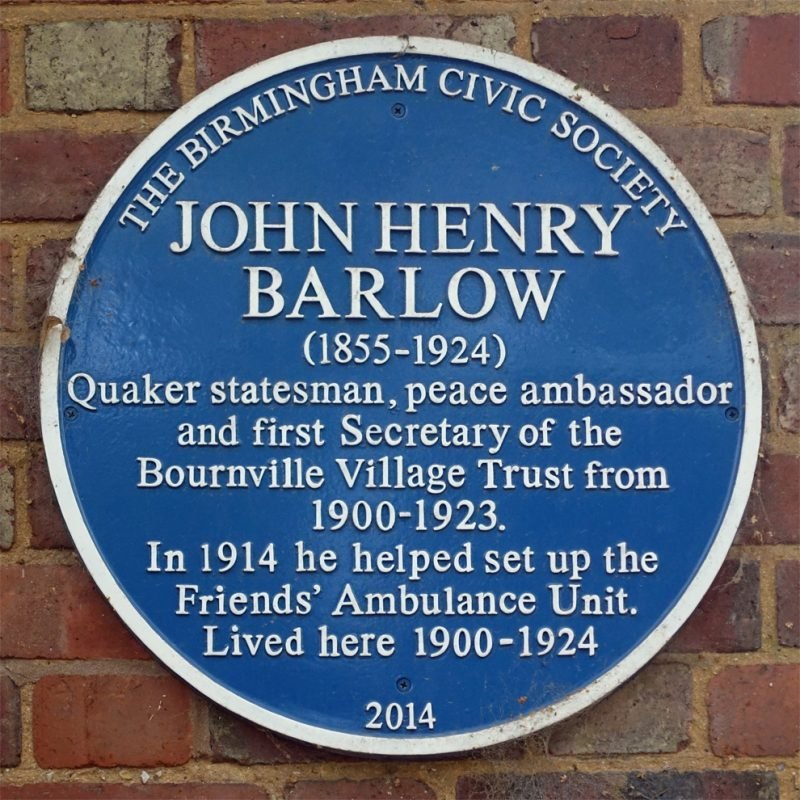
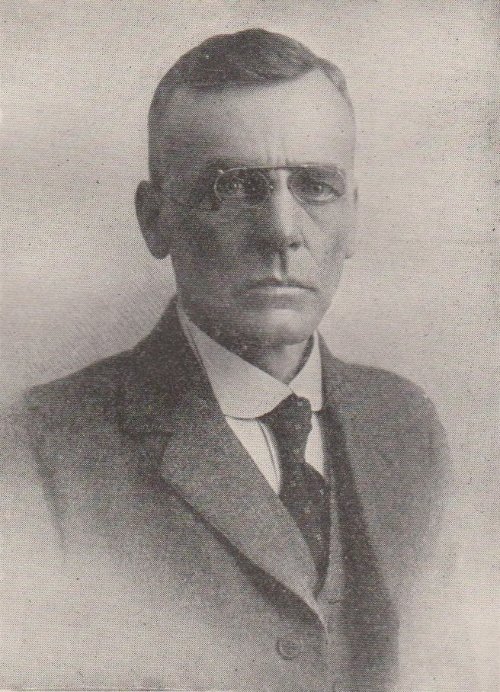
John Barlow was an incredibly influential Quaker, described by many as “the outstanding Quaker statesman of his generation.”
From Edinburgh to Birmingham’s housing revolution Although born in Edinburgh, Scotland, his life and work became deeply associated with Birmingham, particularly through his pioneering role in the Bournville Village Trust. Barlow’s commitment to social improvement and peace was evident from a young age. Despite his education being cut short due to financial hardship, he dedicated his leisure time to religious and social service, becoming involved in the temperance movement and serving as secretary to the YMCA in Carlisle.
The Bournville pioneer In 1900, John Henry Barlow was invited by George Cadbury to become the first secretary and general manager of the newly formed Bournville Village Trust (BVT) in Birmingham. This marked the beginning of 23 years of devoted work on this groundbreaking social housing experiment. Barlow, alongside George Cadbury, worked to provide healthy homes and pleasant surroundings for the poor of the city and those working for Cadbury’s, establishing a standard for housing reform that inspired projects worldwide. He studied housing developments across Europe and became an authority on community housing, influencing figures like Henrietta Barnett, founder of Hampstead Garden Suburb.
Wartime Quaker leader Beyond his work at Bournville, Barlow was a prominent figure within the Society of Friends (Quakers). He served as Clerk of London Yearly Meeting from 1913 to 1920, a crucial period during the First World War. His leadership was vital in maintaining unity within the Society during the war years, demonstrating a remarkable ability to bring together differing viewpoints. He also played a key role in the Friends’ Ambulance Unit, formed in 1914. After the war, he led a delegation to Ireland to investigate alleged atrocities committed by the Black and Tans.
Birmingham’s social conscience Until his death in 1924, Barlow remained Birmingham’s champion of social justice. His Bournville model proved that decent housing, green spaces, and community spirit weren’t luxuries – they were rights that transformed lives and inspired a global movement for better urban living.
Image Gallery
More Information
For further information about John Henry Barlow, please see selective links below.