Birmingham beginnings
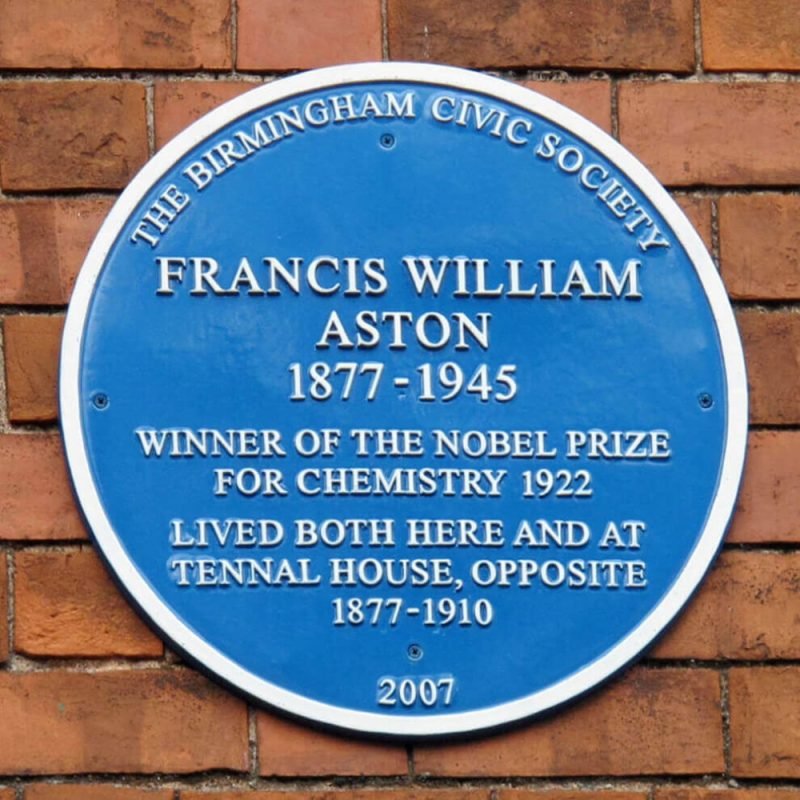
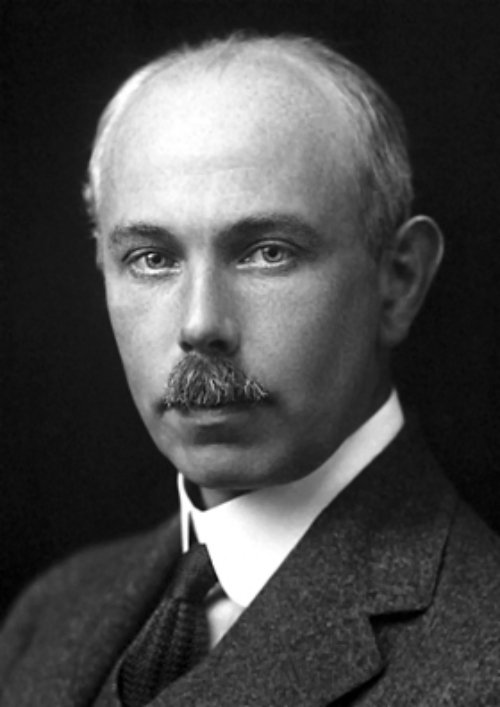
Francis Aston was a distinguished British chemist and physicist, and a Nobel laureate, with strong connections to Birmingham. Born in Harborne on 1st September 1877, he received his early education locally before attending Malvern College. His scientific journey began at Mason College (which later became the University of Birmingham), where he studied physics under John Henry Poynting and chemistry under P.F. Frankland and W.A. Tilden.
From brewery to breakthrough
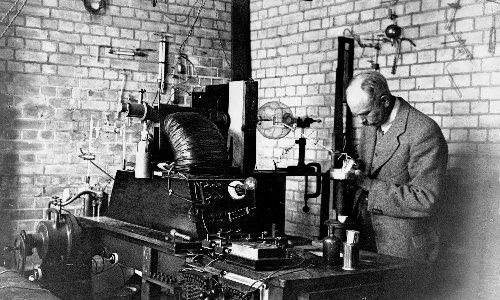
Initially, Aston pursued a career in brewing chemistry, working for W. Butler & Co. Brewery. However, his true passion lay in physics. He returned to the University of Birmingham in 1903, conducting research on the properties of electrical discharges in gases. His innovative spirit led him to design and build new types of vacuum pumps, which proved crucial for his later work.
Cambridge and Scientific Glory.
In 1910, Aston moved to the Cavendish Laboratory at Cambridge, invited by Sir J.J. Thomson, the discoverer of the electron. It was here that Aston made his most significant breakthroughs. During his time as Thomson’s assistant, the first evidence for isotopes—atoms of the same element with different masses—was observed for neon. Following the interruption of the First World War, during which Aston worked at the Royal Aircraft Establishment, he returned to Cambridge.
Nobel Prize achievement
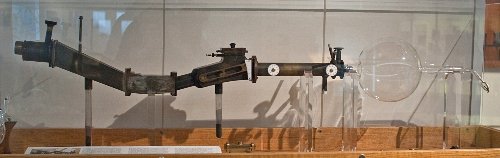
In 1919, Aston invented the mass spectrograph, a revolutionary apparatus that allowed him to precisely measure the masses of atoms and identify isotopes. With this ingenious device, he systematically discovered 212 of the naturally occurring isotopes and formulated the “whole number rule,” which states that the masses of isotopes are very nearly whole numbers when compared to oxygen. For these groundbreaking discoveries, he was awarded the Nobel Prize in Chemistry in 1922.
Beyond scientific genius
Aston was also a keen sportsman, enjoying skiing, rock climbing, tennis, and swimming. He was musically talented, playing the piano, violin, and cello, and was also an avid photographer and astronomer, participating in several expeditions to observe solar eclipses. Francis William Aston died in Cambridge on 20th November 1945. His pioneering work with the mass spectrograph laid the foundation for much of modern atomic and nuclear physics.